
Visit Our Website | Explore More Blogs
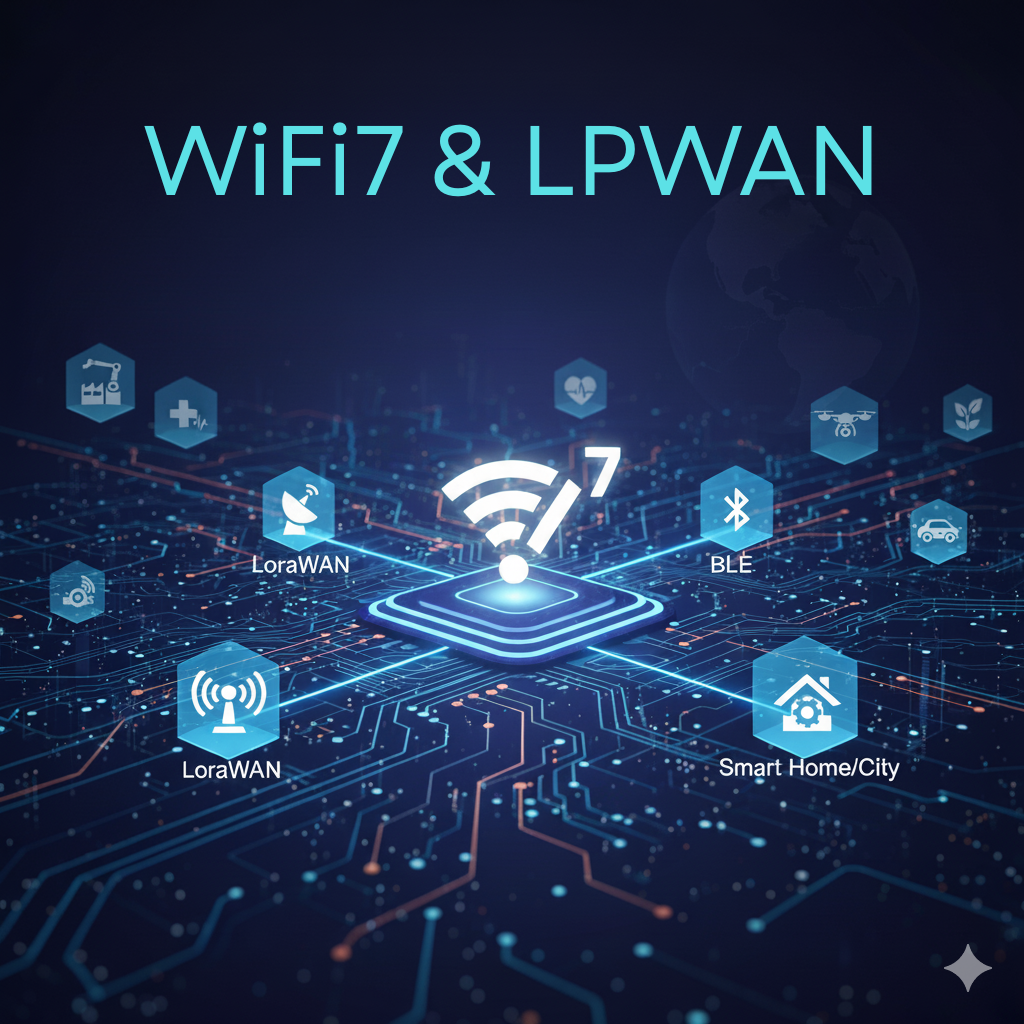
IoT is evolving at lightning speed. By 2030, billions of devices will rely on smart, connected networks — from smart homes and cities to industrial automation and healthcare. But one truth is becoming clearer than ever: no single protocol can meet every IoT need.
This is where hybrid network designs come in. By combining WiFi 7 with LPWAN technologies like LoRaWAN, supported by short-range protocols like BLE, enterprises can build IoT ecosystems that are not only powerful but also future-proof.
Let’s break down why decision-makers should pay attention to this hybrid future.
Why WiFi 7 Matters for IoT
WiFi 7 is set to redefine connectivity standards with:
- Ultra-low latency for real-time applications (think AR/VR in factories or telemedicine).
- Massive bandwidth to support data-hungry devices.
- Improved reliability through multi-link operation, reducing downtime.
For high-density deployments — airports, campuses, enterprise offices — WiFi 7 provides the backbone needed for speed and capacity.
But here’s the catch: WiFi alone can’t deliver when it comes to low-power, long-range use cases.
Why LPWAN (LoRaWAN) Remains Essential

Low-Power Wide-Area Networks (LPWANs), especially LoRaWAN, are designed for:
- Ultra-long range communication across cities and industrial sites.
- Low power consumption, enabling devices to run for years on small batteries.
- Scalable deployments for thousands of devices in logistics, agriculture, or utilities.
LoRaWAN doesn’t compete with WiFi 7 — it complements it. While WiFi handles heavy data and local traffic, LoRaWAN ensures reliable, energy-efficient connectivity across distances.
BLE: The Missing Piece in Hybrid Designs

Bluetooth Low Energy (BLE) fills the short-range, low-power gap. It enables device-to-device communication, indoor positioning, and wearables integration. In hybrid IoT architectures, BLE plays a critical role in edge connectivity before data moves to WiFi or LoRaWAN.
The Case for Hybrid IoT Networks
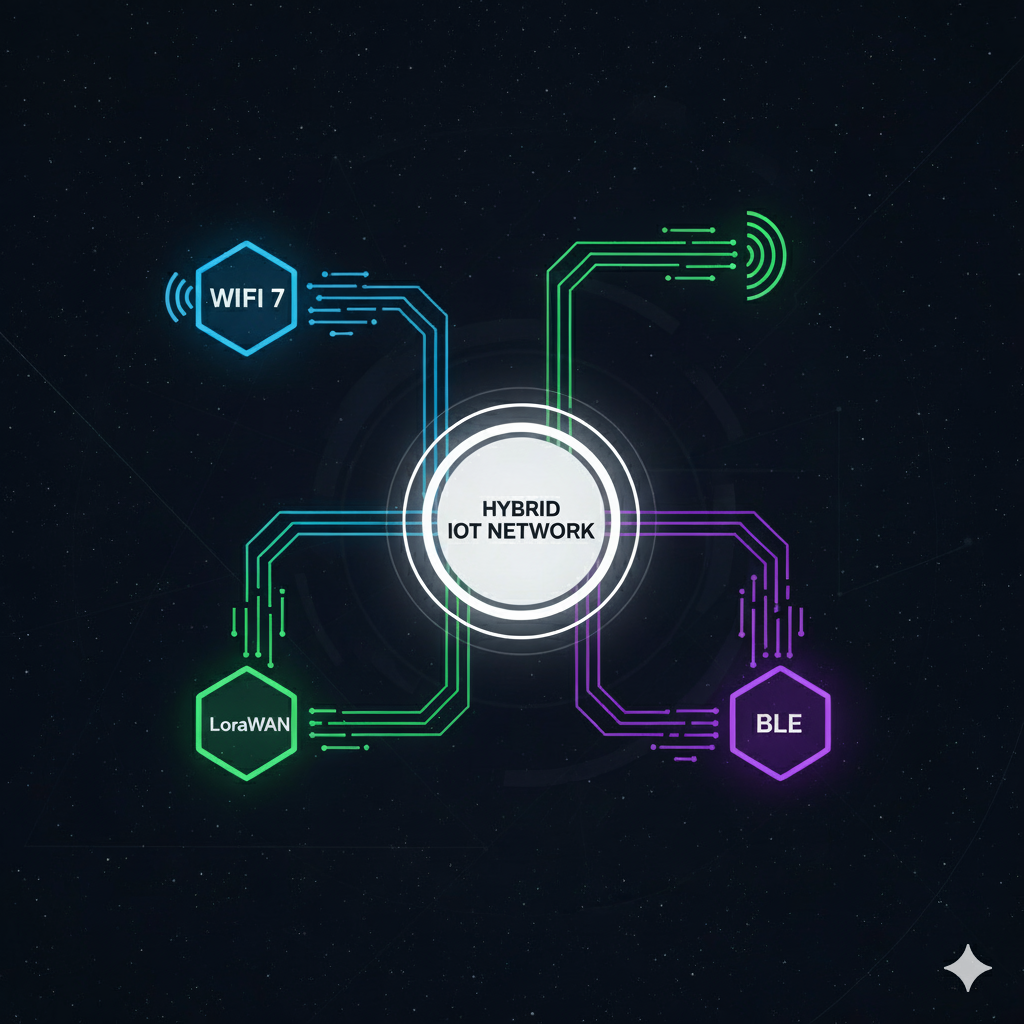
No protocol wins on its own. The future is about coexistence:
- WiFi 7 → High-bandwidth local connectivity.
- LoRaWAN (LPWAN) → Low-power, long-range communication.
- BLE → Low-energy, short-range and device-to-gateway links.
Together, they create networks that are:
✅ Cost-efficient → Optimize power and cloud costs.
✅ Scalable → Support both dense device clusters and wide-area coverage.
✅ Resilient → Avoid single-point dependencies.
What This Means for Decision-Makers

For CIOs, CTOs, and IoT project leaders, the key takeaway is this: build with flexibility in mind. Don’t lock your strategy into one protocol or vendor ecosystem.
Instead, design networks that embrace hybrid architectures with multi-protocol IoT gateways. This ensures your deployments remain adaptable to future technologies, regulations, and scale requirements.
LINK⇌LOGiX: Building the Hybrid Future

At LINK⇌LOGiX, we design IoT gateways and modules that bridge LoRaWAN, WiFi, and BLE into one flexible solution. Our mission is to help enterprises and smart city planners deploy IoT networks that are scalable, secure, and future-proof.
Explore more insights on our IoT Blogs — where we share practical strategies for building networks that keep pace with the future of connectivity.
Check out our IoT solutions that will support and enhance your operations in the best way possible.
❓ FAQs
Q1. Why isn’t WiFi 7 enough for IoT?
Because IoT has diverse needs — WiFi 7 handles high bandwidth but drains power and has range limitations. LPWAN and BLE fill those gaps.
Q2. What industries benefit most from hybrid IoT networks?
Smart cities, logistics, utilities, healthcare, and large campuses where a mix of long-range, short-range, and high-data devices coexist.
Q3. What role do IoT gateways play in hybrid networks?
Gateways act as the integration layer, ensuring devices across WiFi, LoRaWAN, and BLE communicate seamlessly without vendor lock-in.